
Who approves, and why it's them
The org chart lives in a slide that's wrong the day after it's drawn. Organisation management makes the structure itself the source of truth: readable on any date, carrying the responsibilities that belong to each unit, so approvals and reporting lines come straight from it.
When structure is just a picture
A drawing on a slide can't tell you who approves for this team, or what the structure looked like in June. So the real work drifts away from it, and this is what that can cost.
The structure the whole platform reads
Legal entities, org units, reporting lines and work patterns, modelled once in Popay Core and read by every module, from Asset management to Vetting. The structure is dated and keeps its versions: load it as it stood last June, as it will stand after the reorganisation, or clone a version to draft the next.
Structure has more than one shape. Your HR reporting line and your cost-centre structure are rarely identical, so model both in parallel. The systems outside Popay read that same structure through Popay Connect, so it is maintained once.
Model it once. Payroll, approvals and reporting all read the same structure.
Every responsibility, owned by a role on the structure
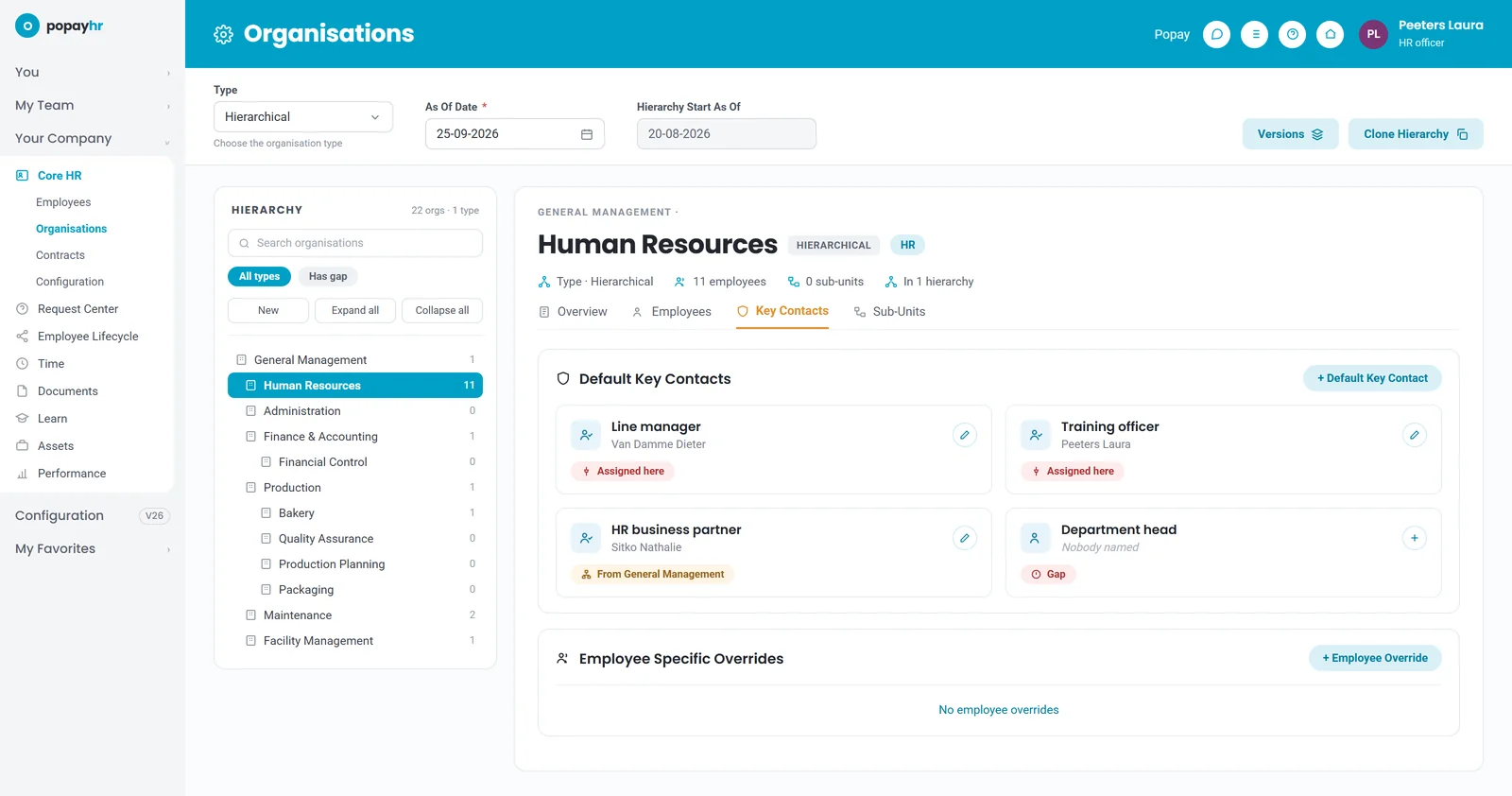
You define the roles your organisation actually has, and name someone for each one on the department it belongs to. A single employee can have someone different from what their department says, through an override that applies to that person alone. People move; the role stays attached to the structure.
Every role has someone, or Popay HR says there is nobody
You record who takes on a role, per department. Leave it empty and the person from the department above applies, and when nobody is named anywhere in the line, Popay HR says so. This page is about who carries which responsibility; the tasks that fire when people join, move and leave come from Employee lifecycle.
You name someone
You name someone for this department. Everyone in it, and in every department under it, ends up with that person.
The department above fills it
When a team has nobody named, the person from the department above applies. A small team inherits its department head that way, and nobody keeps the same name in two places.
Nobody anywhere
When nobody is named anywhere in the line, Popay HR counts that as a gap, shows it on the department and offers a filter listing every department with one.
Questions about who signed off have an answer
An internal audit asks why this person approved that request. A new department head asks what they now own. A manager asks who covers a team while they are away. Each of those is a lookup, and the answer is the same one the platform used when it routed the approval in the first place.
One structure, one answer. The same one the platform used.
Make the structure do the work
Model your organisation once, name someone for every role, and let approvals follow the structure as people join, move and leave.
Book a demo →