
Know what you own. Know who has it.
Nobody's quite sure how many laptops the company owns, or who's holding them. A leaver walks out with a phone still on the account. A car lease renews off a spreadsheet someone forgot to update. Issued kit is company money in people's hands. Asset management keeps every issued asset on the employee record, from the day it's handed over to the day it comes back.
What you can't see, you can't manage
Assets are easy to hand out and easy to lose track of. Tracked off-platform, this is what it can cost.
One register: every asset, on the record
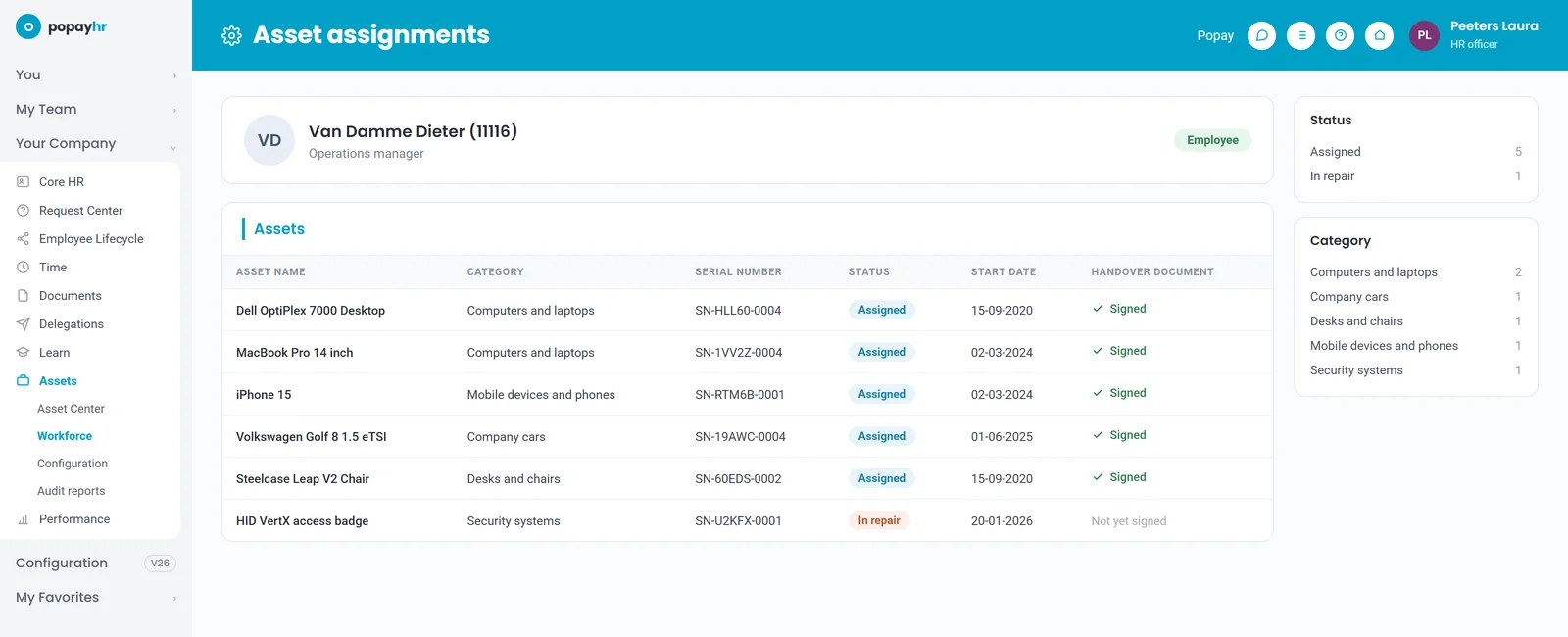
Every issued asset on the record: category, tag, serial number, status, location and supplier, linked to the person who holds it. The assignment history stays there too, so you know what went where and when it came back.
Employees see their own assets in self-service, with the warranty and the manual in the same place as their payslips and contracts, and roles deciding who sees which. No asset gets assigned while it is in for service.
One source for kit. What, where, who, and what it's worth.
Every stage of an asset's life
An asset is more than who holds it. It carries documents, a value, a supplier and a service history. All of it lives on the asset record.
Documents & validity
Purchase invoices, warranties, insurance, lease agreements: stored on the asset, with the warranty and lease end dates on the record.
Depreciation
Purchase value, method and residual recorded per asset and updated across its life. One shared figure that HR planning and finance both use.
Supplier & lease
Every asset linked to its vendor or lease company, with contract references on the record. Multi-provider car lease programmes tracked as their own categories.
Maintenance
Every service logged with date, cost and outcome. When an interval expires, the task is created automatically. Per category you set who hears about it: the assigned employee, an administrator, or both.
Assigned, moved and recovered, driven by the event
An assignment can start three ways: an asset manager assigns it directly, an employee raises it in Request management, or an Employee Lifecycle event fires it: a new hire triggering laptop, mobile and badge tasks; a departure listing what has to come back. Run an onboarding journey twice and a duplicate-assignment check stops a second laptop going out.
The event moves the asset. The register remembers every move.
Assets you issue vs. credentials a person holds
A simple test keeps this clean: if you issue it and want it back, it's an asset: a laptop, a mobile, an access badge, a company car. If the person must hold it and you must keep it valid, it's a credential: a work permit, a valid ID, a driving licence for that company car, a professional registration. Credentials live in Vetting, where their validity is monitored. The two often pair up: the car is an asset; the licence to drive it is a credential. But they're tracked in their proper place.
One register, four departments
When every asset sits on the same record as the person who holds it, the questions that used to take a day answer themselves: what do we own, who has it, what's it worth, what's due for service, and what still needs to come back. No parallel spreadsheet, no reconciliation between systems. One source HR, IT, facilities and finance all read.
From assignment to return. On the record, the whole way.
Put every asset on the record
From the day it's issued to the day it's returned, one shared register, with the tasks that move it fired by the event.
Book a demo →