The right to-dos, to the right people
A hire is confirmed, and the chase begins: email IT for the laptop, remind facilities about the badge, tell L&D to assign the training, and just hope everything falls into place. Employee Lifecycle makes the event itself the trigger. HR chases no one.
The coordination tax
Every employment event sets off work in several places at once. When HR is the one holding it together by hand, this is the cost.
Process the hire, the rest follows
Process a hire, a role change or a departure in Popay Core, and the chain starts by itself. There is nothing to open and nothing to remember.
What runs depends on who the person is. You set it per job, location, entity or individual, so a sales hire in Belgium and a manager in the Netherlands each get their own chain, and neither gets the other's.
It can start before someone’s first day. A future employee whose contract has not begun can already be given their mandatory training, so day one is not their first look at the system.
The event fires the chain. No tool to open, nothing to remember.
Manual, monitored, or automatic: your choice, per activity
Not everything needs a person; not everything can be automated. Each activity runs in the mode that fits it.
A person acts
Assigned to the right person, employee via self-service, manager, or HR admin, it appears in their tasks and is completed by hand, with notifications to prompt it.
The system checks and executes
The system checks whether the conditions are met and completes the action by rule, pausing at whatever human checkpoints you set.
The system does it
Triggered and completed the moment the event fires: an access profile set, an activation email sent, a course allocated. No human step at all.
There is no fixed template to follow. Which activities belong to which event, who they apply to, and how each one runs is yours to define, and it looks different for a hospital, a manufacturer and a professional services firm.
One event, every action that follows
In practice across joiner, mover and leaver: automatic actions and human tasks, each routed to the right actor.
Every task has an owner, defined once
Each task goes straight to the role that owns it, configured once and applied on every event. Who owns what is defined in Organisation management; it simply routes to them.
Security officer
Gets the background check on a new hire, a hard gate onboarding can't pass until it's cleared.
IT / Asset manager
Gets provisioning on a hire or move, and recovery on exit.
Direct manager
Gets the human tasks: welcome, team integration, handover.
Any custom role
Payroll officer, compliance manager, facilities. If you have a role for it, Employee Lifecycle can route to it.
Employee Lifecycle spans the whole platform
It connects one employment event to every module that has to act on it. These are the ones it reaches most often.
The Validation Framework is the other cross-cutting layer. Where Employee Lifecycle connects, it validates, checking every transaction as it happens.
From switchboard to overview
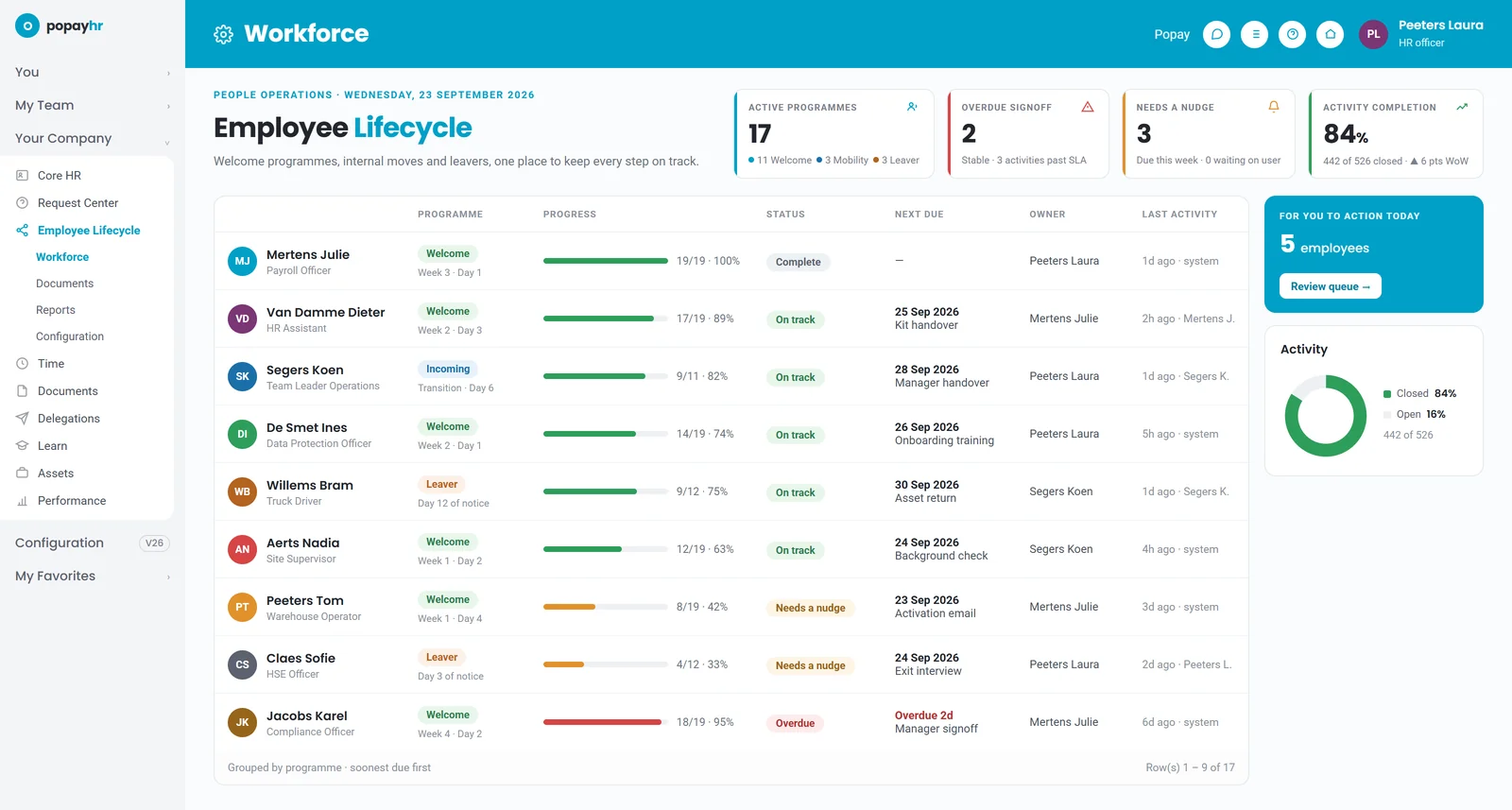
HR stops chasing and gets an overview. One screen shows what is done, what is still open and what is late, for a single employee or for everyone at once. Nothing slips, because nothing depends on someone remembering.
Mark an activity as compliance-relevant and it is followed until it is finished, with a trail an auditor can read. Compliance audits the data and the actions behind it.
The event coordinates itself. HR oversees, instead of chasing.
Today, every step starts with HR
When a hire, move or departure fires, let the right activities run, to the right people, in the mode you choose, without HR chasing a single one.
Book a demo →