It starts with an architecture choice.
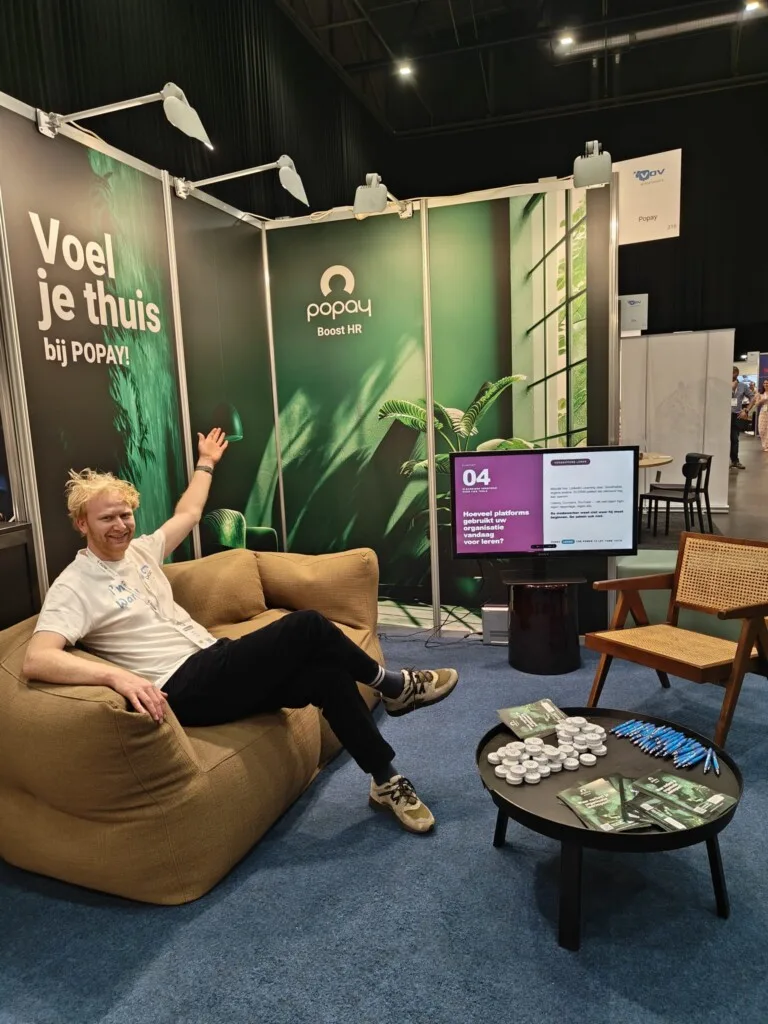
What we heard at the VOV trade fair confirmed what we’ve seen for years: most organisations are building on quicksand.
PH | Popay HR | June 2026 · 5 min read
The reality
60% manage L&D through Excel today
60% — manage L&D through Excel today. And not just small SMEs.
We asked the HR professionals we spoke to directly: how do you manage your L&D data today? More than 60% answered: through Excel. And not just small SMEs.
One of the conversations that stuck with us: a multinational, present in several countries, thousands of employees worldwide. At global level a system is imposed. One platform for everyone. Big, expensive, impressive on paper. But it doesn’t meet the local needs. So what does the local HR team do? They build alongside it. Their own Excel. Their own logic. Their own shadow world that no one at global level sees.
We told this story at the fair. Heads nodded. Everyone recognised it.
That’s not the exception. That’s the pattern.
The real problem
The real problem isn’t Excel
Excel is a symptom. The real problem is an architecture choice that was never made consciously: data scattered across systems, files and people, without anyone having the full picture.
The result is that the most basic questions go unanswered. Who has followed which training? What did it cost? What did it deliver? Which skills are missing in which department? Nobody knows. Not because the data doesn’t exist, but because it never comes together.
Budgets are approved on gut feeling. Initiatives are extended out of habit. And at the end of the year, finance wonders what exactly happened to that L&D budget.
Bringing that scattered training data into one place — for example a dedicated module like Popay Learn — is the first architectural step.
Multi-entity
Multi-entity makes it structurally worse
For organisations with multiple entities or locations, this isn’t an operational inconvenience, it’s a structural problem. Every entity has its own way of keeping records. Consolidating doesn’t work, or only manually, with all the risk of errors that entails. The big picture simply doesn’t exist.
And then AI arrives
And that’s now — not ten years from now
This is where it becomes urgent. AI is going to fundamentally change the way organisations analyse HR data. Not ten years from now. Now. But AI only works if there’s something to work with.
What becomes possible once L&D data IS consolidated?
Skill gaps in minutes
Missing competencies per department become visible in minutes — not weeks.
Data-driven recruitment
Not “we need someone”, but “these are the three profiles missing in this team.”
Measurable ROI
Which training programmes correlate with better performance, less absenteeism, higher retention?
Automated learning paths
Suggested based on role, profile and organisational objectives.
The reality today
If that data isn’t there, it’s simply not possible to apply models to it. Not because the AI is too weak. But because there’s nothing to work with.
Anyone who doesn’t have their L&D data — and by extension their HR data — in order today shuts themselves out of what will be possible tomorrow with data-driven HR.
The scan
How mature is your L&D policy?
The question isn’t whether your organisation will ever face this. The question is whether you’ll be ready when the time comes. An honest measurement starts with knowing where you stand today.
Still available: Take the L&D Maturity Scan
At the VOV fair, participants could complete an L&D Maturity Scan. The response was exceptionally enthusiastic. The scan assesses how your organisation scores across four dimensions:
- L&D anchoring
- Ownership
- Measurability
- Practical execution
For many participants, it was the first time they examined their L&D policy so concretely. And the results were often an eye-opener. The scan is still available — for a limited number of participants, there’s a follow-up option for a personal conversation to review the results together.
No sales pitch. Just an honest conversation about where your organisation stands.
The approach
Not an implementation project. A partnership.
Popay HR is built modularly. You can start small — consolidate one process, merge one data source — and expand from there.
But there’s something that fundamentally sets us apart from most HR software vendors. We’re not an implementation partner who turns off the lights at go-live. We’re an HRIS architect. That means we help build your HR architecture for the long term, because an HRIS is never finished. Organisations evolve, legislation changes, teams grow. A good HRIS grows with them.
The starting point is always the same: all data must be consolidated to arrive at correct analyses and real ROI. Not as the endpoint of a multi-year roadmap, but as a building principle from day one.
What are the L&D processes in your organisation that today live outside your HR system? That’s the question every conversation with us starts with.
What you can do today
Bring your L&D out of the dark.
Centralise what is scattered. Integrate what runs in isolation. Start with the scan, and see where your organisation really stands today.
Take the L&D Scan → | Request a conversation
Tags: L&D · HR Data · AI · ROI · Multi-entity · HRIS Architecture · VOV 2026
Read next: training in Excel, the five FLA obligations, and programmatic assessment at Summa. More HR insights.