Why global payroll becomes difficult as organisations grow
Running payroll in one country is already deadline-driven. Running it across several countries adds a second challenge: every payroll must remain locally correct while group leaders still need consistent oversight. The difficulty is rarely one isolated calculation. It is the interaction between different regulations, calendars, currencies, providers, data formats and approval practices.
For a Group HR Director, the result can be frustrating. Local teams may complete payroll successfully, yet consolidated reporting still arrives late. Finance may receive different cost classifications from each entity. Leadership may struggle to answer a simple question: has every employee been paid accurately, compliantly and on time?
The five sources of multi-country payroll complexity
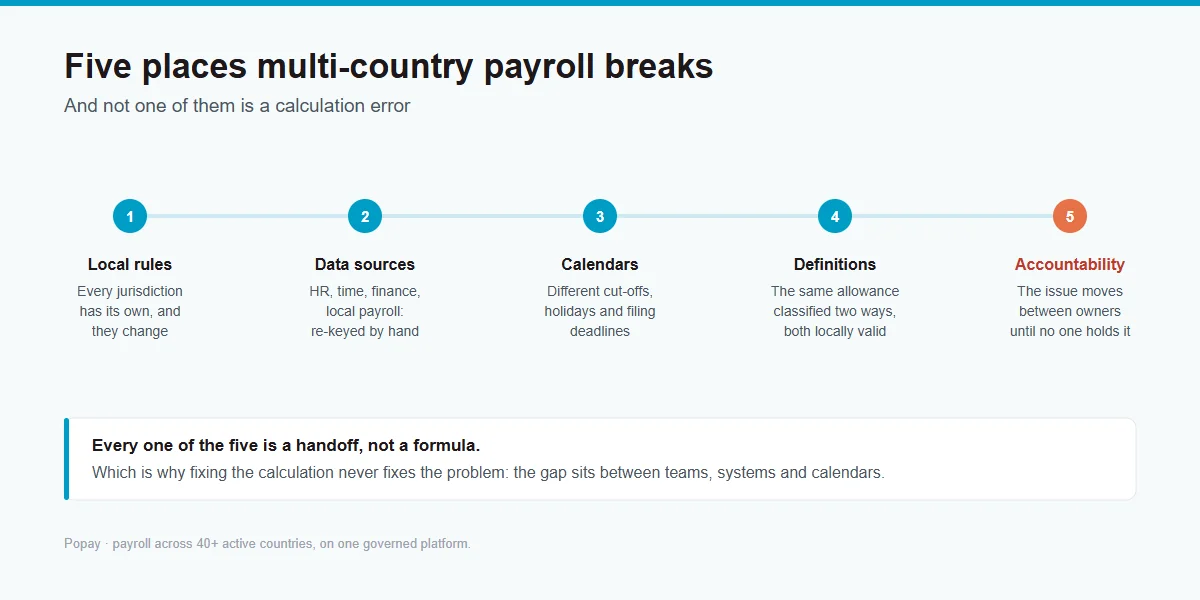
1. Every jurisdiction has its own rules
Tax, social security, statutory reporting, leave, benefits and termination rules differ by jurisdiction and change over time. A process that is correct in one country cannot simply be copied into another. Global governance must therefore allow local expertise without losing group control.
This is where the delivery model decides the outcome. Popay country rules run natively inside our own gross-to-net engine, monitored and kept current by a Pan-African team, rather than stitched together from third-party aggregators. The difference shows up the month a regulation changes: either the update reaches the engine, or someone has to notice it.
2. Payroll data arrives from several systems
Employee records, time data, bonuses, allowances and organisational changes may come from different HR, time, finance or local payroll systems. When interfaces are weak, teams re-enter or reconcile the same information. Each manual handoff adds time and creates another opportunity for error.
3. Calendars and approvals do not align
Countries may follow different cut-off dates, pay frequencies, public holidays and statutory submission deadlines. Without a shared calendar and escalation process, group teams discover risks too late, often when a local payroll is already close to finalisation.
4. Reports use different definitions
One entity may classify an allowance as regular pay while another records it separately. Even when both treatments are locally valid, group reporting becomes difficult. Consolidation requires a common data dictionary, agreed mappings and transparent exceptions.
5. Accountability becomes unclear
The more vendors, entities and internal teams involved, the easier it is for an issue to move between owners. A resilient operating model defines who prepares, validates, approves, submits and resolves each payroll activity.
What good global payroll management looks like
A strong global payroll model does not erase local differences. It makes them visible and manageable. Group leaders should be able to see payroll status, exceptions, deadlines and results across countries while local specialists retain responsibility for statutory accuracy.
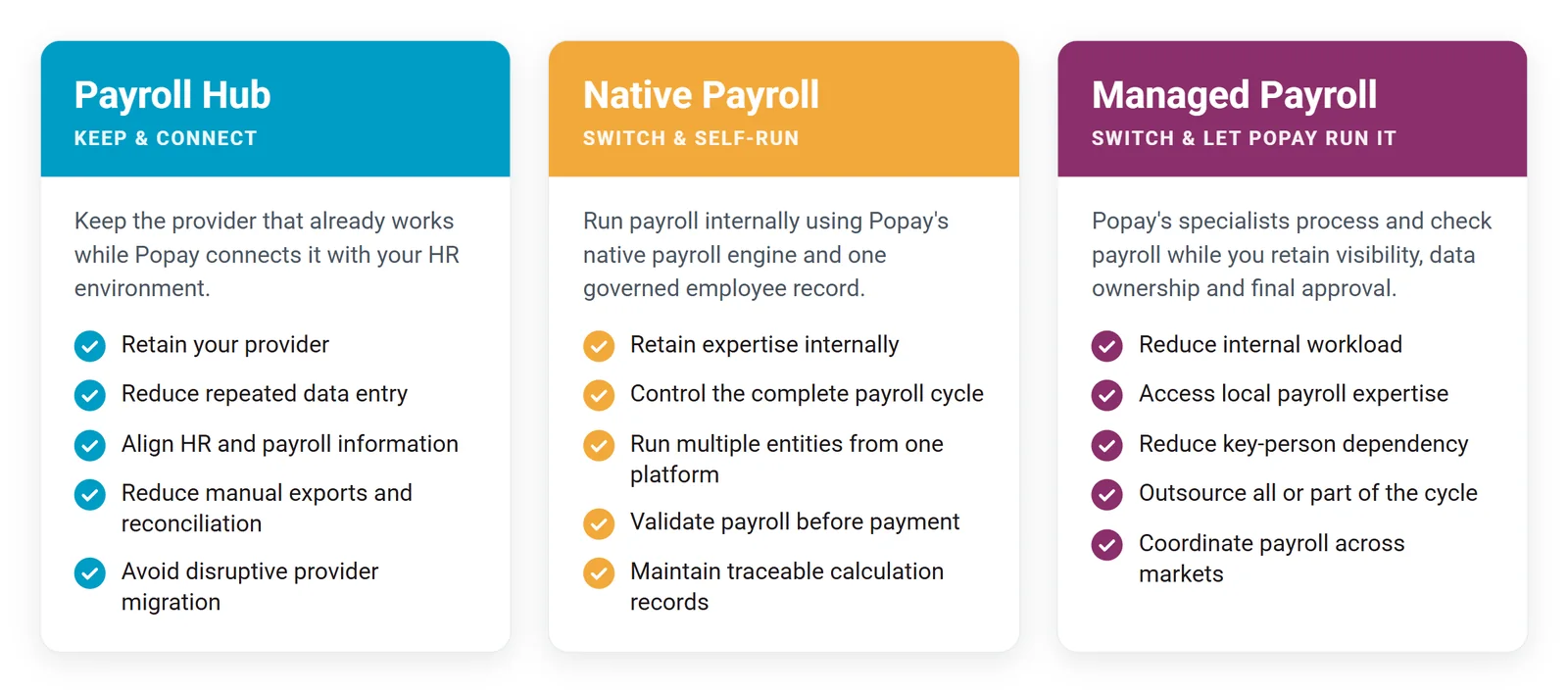
In practice, that framework has to accommodate different delivery models side by side. Some entities keep the payroll provider they already have and connect it to the group platform. Others run the group engine natively. Others hand the whole cycle over and simply approve it. What has to stay identical across the three ways to run payroll is the governance, the calendar and the reporting.
- One governance framework with documented local variations
- Standard input templates and controlled data interfaces
- A common payroll calendar with ownership and escalation paths
- Pre-payroll validation and post-payroll variance checks
- Consolidated reporting based on agreed definitions
- Audit trails for changes, approvals and submissions
- Service measures covering timeliness, accuracy and issue resolution
A practical four-step improvement approach
- Map the current landscape. Record every entity, system, provider, calendar, interface and owner.
- Identify the highest-risk handoffs. Focus on repeated data entry, spreadsheet consolidation, late approvals and unclear exceptions.
- Standardise what should be common. Align data definitions, controls, reporting and governance while documenting necessary local differences.
- Create group visibility. Use dashboards and exception reporting so leaders can intervene before a deadline is missed.
Technology is only part of the answer
A platform can connect workflows, consolidate reporting and strengthen control, but technology cannot compensate for unclear ownership or poor data. The best programmes combine payroll expertise, integration capability, local compliance knowledge and disciplined governance.
For a sense of what that combination looks like at scale: 20+ years in HR and payroll, 70+ experienced professionals, 250+ customer organisations, 70,000+ users across Africa and Western Europe, and 40+ active countries.
Popay supports organisations that need to coordinate payroll across countries while connecting HR, payroll and business systems. The objective is not merely to process more payrolls. It is to give local teams the tools they need and group leaders the visibility they require.
Client example: coordinating payroll across 23 African countries
An international NGO operating across 23 African countries needed to accommodate country-level payroll requirements while improving coordination across its regional operations. Popay’s experience in this environment illustrates why multi-country payroll needs both local processing capability and a consistent framework for oversight. It is the same principle that applies to global groups: local payrolls must remain compliant, but leadership also needs dependable visibility across countries.
Two published examples from a very different context make the same point. The Province of Antwerp moved off an expensive package onto Popay, and Radboudumc significantly shortened the workflow that brings a new employee on board, by connecting systems rather than adding another one. Different geography, identical principle: the gain comes from connected data and clear ownership.
Frequently asked questions
What is global payroll?
Global payroll is the coordinated management of employee pay across multiple countries. It combines local statutory compliance with group-level governance, data, reporting and service oversight.
Should every country use the same payroll process?
The controls and reporting framework can be standardised, but local calculations, declarations and deadlines must reflect each jurisdiction.
When should a company review its global payroll model?
Common triggers include international expansion, an acquisition, repeated reconciliation problems, poor consolidated reporting, an expiring provider contract or a compliance concern.
Is your organisation managing several locally correct payrolls but still lacking one reliable group view? Request a multi-country payroll review with Popay.
Read next: the HR challenges in Africa guide for the African version of this question, why a start-up chose to outsource its payroll, and Popay three years running in the Everest Group PEAK Matrix. More HR expertise.