Over the past few months I spoke with dozens of L&D professionals. Different sectors, different sizes, different budgets. But always the same sentence, at a certain point in the conversation.
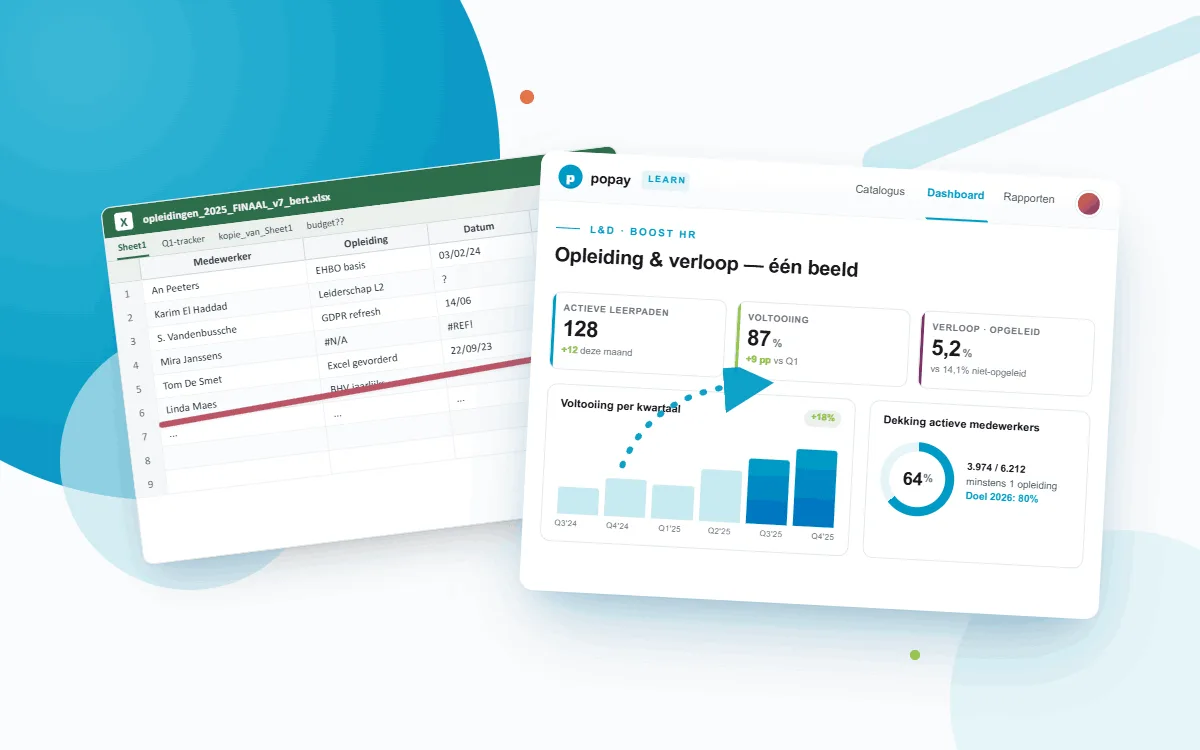
Not because they aren’t doing their job well. But because the data is fragmented. An LMS here, an Excel there, HR systems that don’t talk to each other. And an HR team with other priorities. Proper learning management only becomes strategic once that data connects to the rest of HR.
“We know what we do. We don’t know what it delivers.”
— L&D lead · 480 employees
The result is predictable: L&D reports on activities. Number of trainings. Number of participants. Satisfaction score. Not on impact. Not on the difference training makes to retention, productivity or advancement.
The hesitation is justified
Anyone who has these conversations quickly notices that the word “system” carries a certain weight. Not out of incompetence — quite the opposite. L&D professionals have often already watched several IT projects come and go: projects that took longer than promised, cost more than budgeted, or ended in a tool that did not quite do what was needed.
That caution is healthy. It’s not cold feet, it’s experience. And it’s also a matter of priorities: L&D people are focused on people and learning journeys, not on data models. Rightly so.
But what I propose below is not an IT project. Not a migration. Not a vendor switch. It’s something much smaller. And far more powerful.
Start with a single connection
What if your training data simply knew who works in which department? Who has just joined? Who has left?
Nothing more than that. No big project. One connection between what you already track and what HR already tracks.
| What you track | LMS & Excel · Trainings, attendance, scores |
| + | |
| What HR tracks | Employee record · Department, intake, departure |
| = | |
| What you can tell | The story behind the numbers · Cross-tabs, no rocket science |
Nothing more than that — no IT project, no migration, no vendor switch.
Once that connection exists, you can ask questions you can’t ask today:
Questions you can’t ask today
Three cross-tabs no one else in your organisation can produce.
- Which trainings did people who left within the year take — and which did they not?
- In which departments does it take longer for new employees to become fully productive?
- Where is training participation high — and what do we see reflected there in retention?
These aren’t complicated analyses. They’re cross-tabs. But they tell a story that no one else in your organisation can tell. That is what data-driven HR actually looks like — questions answered, not dashboards for their own sake.
The conversation that changes
If you can tell that story, you are no longer the person who organises trainings.
You become the person who explains why some departments thrive and others don’t. Why turnover in one team is structurally higher. Why onboarding time in a certain division is twice as long as elsewhere.
That is strategic weight. And you don’t get it by buying a package.
A plan at your own pace
This is exactly where an HR architecture partner makes the difference. Not someone who sells you a system. Someone who builds a blueprint together with you: where you are now, where you want to go, and which steps you take, at your pace, within your budget, with an eye on what it delivers.
Step one might just be making that one connection. Step two is a first dashboard. Step three is using that dashboard in a conversation with your leadership. Three steps that each work on their own — and together build something.
The end goal: an organisation where people know they can grow. Where learning is not an obligation, but a signal of appreciation. Where turnover drops — not because you work harder, but because the environment makes the difference.
That is a journey. Not an implementation.
WHAT NOW? Two ways to keep the conversation going.
● LIVE EVENT · LEUVEN
26 May 2026
VOV Learning & Development fair
Booth Popay K218 · all day · ongoing conversation
- Ward Bollens — HRIS architect · draws the architecture
- Bert Vandenbussche — Popay · brings the stories
Together we make time for anyone who wants to bring their questions. No pitch. A white paper that takes shape on the spot.
At your own pace
Plan an architecture conversation.
No demo, no quote. Together we sketch where you stand, where you want to go, and which single connection is worth making first.
- 45 minutes, online
- You get a blueprint, not homework
- Three steps — take them one at a time, on your budget
About the author
Bert Vandenbussche
HR System Architect · Popay
Bert helps Belgian HR leaders draw their stack instead of getting stuck in a template. Twenty years in HR & payroll, hundreds of client conversations, one common thread: the standard covers 80%, targeted customisation does the rest — both within one open platform.
Read next: measuring L&D starts with architecture, the individual training account and its five obligations, and how AVR rolled out Popay Learn. More articles from our experts.